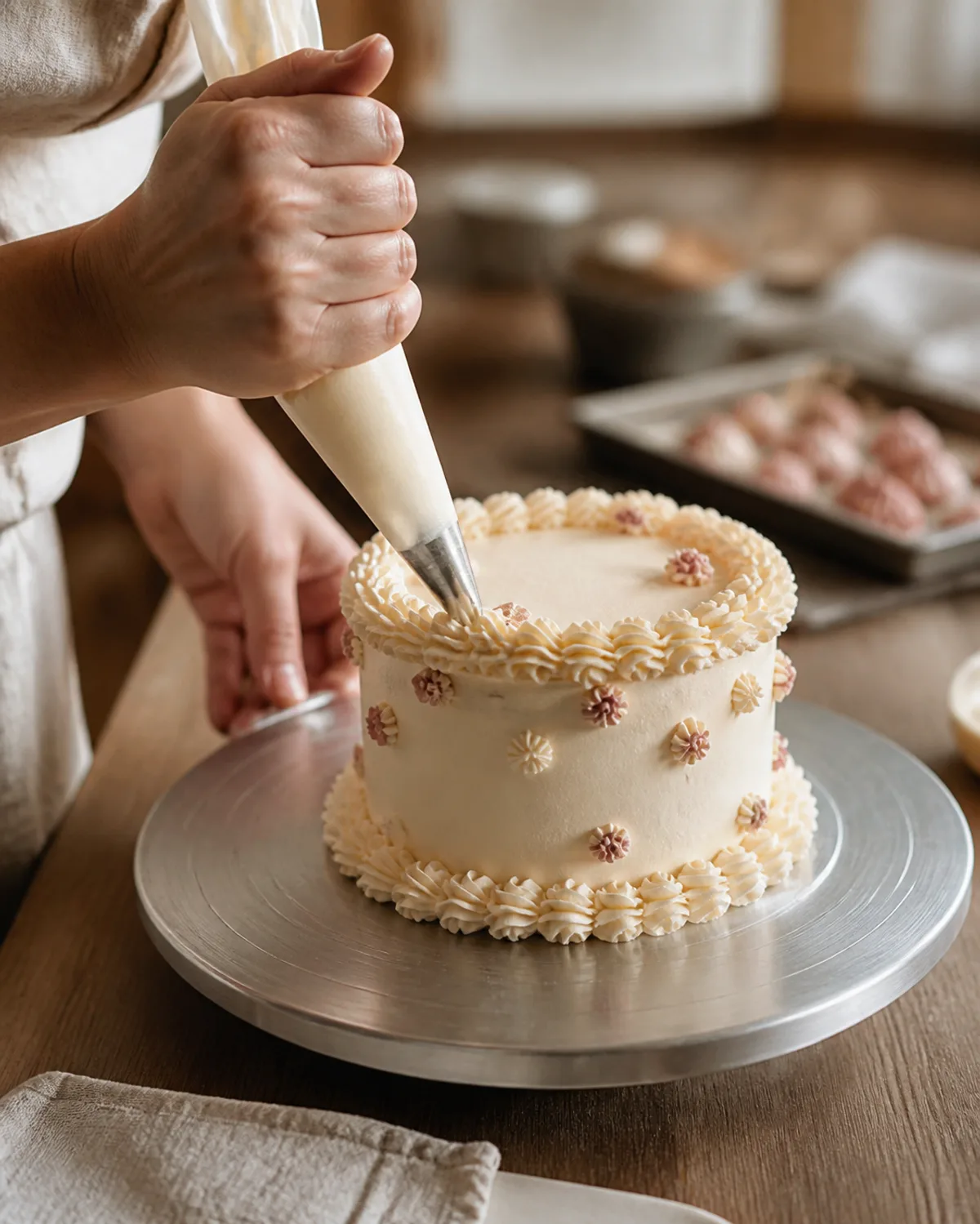
Buttercream and fondant are not opposing levels of quality. They are different decorating materials with different strengths. Recipes also vary from baker to baker, so the final sweetness, mouthfeel, colour and stability cannot be judged by the finish name alone.
In short: Choose buttercream for a softer eating experience and organic textures. Consider fondant for a very smooth, graphic or sculptural finish. For either one, plan an air-conditioned journey and a cool display away from sun; no decorative coating makes a filled cake heat-proof.
Buttercream and fondant at a glance
| Consideration | Buttercream | Fondant |
|---|---|---|
| Overall look | Soft, tactile, piped or deliberately textured | Smooth, tailored, graphic or sculptural |
| Eating texture | Creamy and yielding; recipe determines sweetness | A soft sugar paste over an underlayer; some guests leave it aside |
| Fine details | Excellent for piping, palette textures and relaxed edges | Useful for crisp shapes, cut-outs, embossing and modelled elements |
| Warm conditions | Can soften, slump or lose sharp detail as it warms | Can soften, sweat or become sticky in heat and humidity |
| Best decision basis | Flavour preference, design, filling, venue, display time and transport plan | |
What exactly are buttercream and fondant?
Buttercream is a family of frostings made by combining fat with sugar and, depending on the style, ingredients such as egg whites or flavourings. Some versions are very sweet and sturdy; others are silkier and more temperature-sensitive. It can fill a cake, cover it and create decoration through piping or hand-applied texture.
Rolled fondant is a pliable sugar-based covering rolled into a sheet and laid over a prepared cake. It usually sits over a buttercream or ganache layer that creates an even foundation. Fondant may also be shaped into decorative pieces, figures and dimensional details.
The important point is that the visible outer finish is only one part of the cake. The sponge, filling, internal supports, underlayer and storage plan all affect how it performs.
Which tastes better?
This is personal. Buttercream becomes part of each forkful and can contribute creaminess and flavour. Its sweetness and richness depend heavily on the recipe and the thickness applied. Fondant has a distinct, chewy sugar-paste texture. Some people enjoy it; others peel it back and eat the cake beneath.
If eating experience is the priority, ask what type of buttercream or underlayer the maker uses and how the chosen filling will be balanced. If possible, select flavours before becoming attached to an exterior. A delicate filling may need stricter chilling than the visual design first suggests.
Which finish suits your design?
Buttercream feels expressive
Buttercream is at home with visible palette strokes, combed lines, vintage piping, soft ombré, florals and intentionally imperfect movement. It can also be smoothed neatly, though its edges retain a naturally softer character. It works especially well when you want the cake to feel romantic, generous, playful or handmade.
Fondant feels tailored
Fondant can create a continuous surface for sharp visual concepts: clean blocks of colour, embossing, cut-out motifs, precise appliqué, illustrated effects and modelled forms. It is often useful when the cake needs to echo a graphic invitation, character or sculptural theme.
Both can look minimal
Minimal does not mean simple to execute. A plain buttercream cake relies on controlled smoothing and proportion; a plain fondant cake exposes every bump in its foundation. Choose based on the character of the finish, not the assumption that fewer decorations always mean less work.
How do they behave in Sri Lankan weather?
Sri Lanka's warm, often humid conditions should be part of the design conversation. Buttercream can soften as its fat warms, while fondant can soften or become tacky as it absorbs moisture. Direct sunlight, a parked vehicle and a long outdoor display are risky for either finish—and for the fillings beneath them.
Fondant is sometimes described as a protective shell, but it does not remove the need to keep a perishable cake appropriately chilled. Buttercream is sometimes assumed to be unsuitable for every warm day, but recipe, structure, transport and display timing all matter. Your cake maker is best placed to advise on the specific recipe and design.
A practical warm-weather plan
- Tell the cake maker whether the venue and vehicle are air-conditioned.
- Keep the box on a flat, supported surface rather than a seat or passenger's lap.
- Avoid direct sun, hot boots and unnecessary stops during transport.
- Confirm when the cake should leave refrigeration and how long it may be displayed.
- Arrange outdoor setup as late as the event allows and keep the table shaded.
What about condensation?
Moving a cold cake into humid air may create condensation on the surface. Touching or wiping it can mark the finish. Keep the cake boxed during the initial temperature change and follow the maker's instructions for that design. For more detail, read our Sri Lankan cake storage and transport guide.
You do not always have to choose only one
A hybrid design can use the best material for each job. A cake might have a buttercream exterior with fondant lettering, cut-outs or modelled decorations. Another might use a fondant-covered display tier alongside buttercream-finished tiers. Ganache may be used beneath fondant or as a visible finish, depending on the recipe and design.
Show the baker the visual result you want rather than prescribing every material. They can explain which combination suits their methods, the flavour, the journey and the venue.
Five questions that usually reveal the right finish
- What do you want each bite to feel like? Think creamy, rich, light, less sweet or textural.
- Is the design soft or precise? Painterly piping and crisp geometric appliqué ask different things of the finish.
- Where will the cake wait? Share honest details about air-conditioning, shade and display time.
- How will it travel? Journey length, vehicle space and road conditions can influence the safest construction.
- Which details are essential? Keep the elements that tell the story and allow alternatives for the rest.
If flavour and appearance point in different directions, ask for options. A good design can often translate a mood from one material into another instead of reproducing a reference image literally.
Common buttercream and fondant questions
Is fondant always better for hot weather?
No. Fondant can also soften and react to humidity, and the filling beneath it may require refrigeration. Suitability depends on the complete cake, the recipe, transport and venue conditions.
Can buttercream look smooth?
Yes. Buttercream can be finished neatly and evenly, although it generally has a softer visual character than rolled fondant. The exact result depends on the recipe and the maker's style.
Can fondant decorations go on a buttercream cake?
Often, yes. Lettering, shapes and modelled accents may be combined with buttercream, but their weight, moisture and placement need to be considered by the maker.
Which finish is less expensive?
Neither is automatically cheaper. Size, recipe, complexity and hours of detailed work affect the quote. A heavily piped buttercream design may take longer than a restrained fondant design, and the reverse can also be true.
Choose with context
Start with the mood, flavour and venue.
Share what you love and where the cake needs to go. Those details make a finish recommendation far more useful.
Start your cake enquiry